Global Journal of Medical and Clinical Case Reports
Spontaneous Pneumomediastinum as a Rare Presentation of Diabetes: A Case Report
1Anesthesiology and Intensive Care Department, Mohammed VI University Hospital, Tangier, Morocco
2Anesthesia and Intensive Care Department, Moulay Youssef Hospital, Rabat, Morocco
3Faculty of Medicine and Pharmacy of Tangier, Abdelmalek Essaadi University, Tangier, Morocco
Author and article information
Cite this as
Touffahi I, Ennafiri M, Touir H, Sbai H, Motiaa Y. Spontaneous Pneumomediastinum as a Rare Presentation of Diabetes: A Case Report. Glob J Medical Clin Case Rep. 2026:13(4):44-46. Available from: 10.17352/gjmccr.000244
Copyright License
© 2026 Touffahi I, et al. This is an open-access article distributed under the terms of the Creative Commons Attribution License, which permits unrestricted use, distribution, and reproduction in any medium, provided the original author and source are credited.Abstract
Spontaneous pneumomediastinum is a rare condition characterized by the presence of air in the mediastinum in the absence of any traumatic or iatrogenic cause, typically occurring in healthy, non-pathological lungs. Vomiting is described as a triggering factor, with sudden intra-bronchial hyperpressure due to Valsalva maneuvers being the most commonly reported hypothesis. This case report describes an atypical complication of diabetic ketoacidosis, revealing previously undiagnosed diabetes through spontaneous pneumomediastinum as the mode of presentation. A young patient with a history of cocaine use presented with intractable vomiting and severe epigastric pain. Upon admission, the patient had tachypnea, dyspnoea, and tachycardia. A CT scan revealed interstitial emphysema with pneumomediastinum, pneumorrhachis, and subcutaneous emphysema. The patient was managed conservatively, with fluid replacement, insulin therapy, resulting in a significant improvement in his condition.
Introduction
Spontaneous pneumomediastinum is a rare condition [1] characterised by the presence of mediastinal emphysema in a healthy lung, in the absence of traumatic or iatrogenic cause. Vomiting has been identified as a potential trigger, although the exact mechanism remains unclear. The most commonly reported hypothesis, is the sudden intra-bronchial hyperpressure with a closed glottis, often resulting from Valsalva maneuvers. The prognosis is generally favorable [1].
Differentiating between primary and secondary causes of pneumomediastinum can be challenging for clinicians. The ideal approach involves ruling out secondary causes, such as Boerhaave syndrome. This rare complication of Diabetic Keto Acidosis (DKA) was first described by Hamman in 1937 [2].
In this case, the authors report an unusual complication of diabetic ketoacidosis in a patient with previously undiagnosed Diabetes Mellitus.
Case report
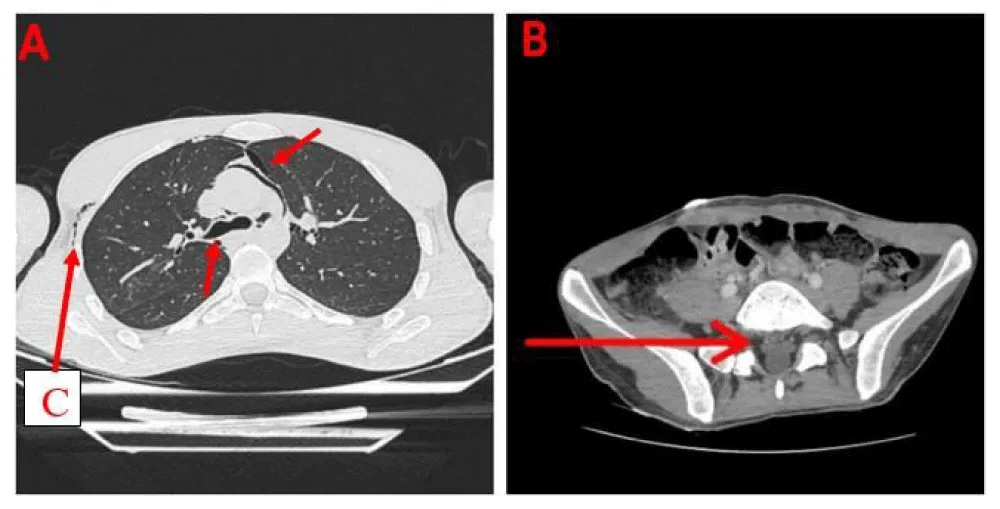
We present the case of a 23-year-old patient with a history of cocaine use, who was admitted to the emergency department with persistent vomiting and severe epigastric pain. He had no other significant medical history. On admission, he was tachypneic with a respiratory rate of 32 breaths per minute, with an oxygen saturation of 98% on room air. He had a clear Kussmaul breathing. Chest examination revealed a long-shaped thorax and cervical crepitus. Hemodynamically, he had a blood pressure of 80/50 mmHg and a heart rate of 128 bpm. He was alert and oriented with no sensory or motor deficits. Laboratory tests showed elevated blood glucose levels and urine dipstick analysis revealed ketonuria, arterial blood gas revealed (2hours after ICU admission) metabolic acidosis with respiratory compensation: pH = 7, 35 PaCO2 = 24mmHg, HCO3- = 13, 2 EB = -12, 4 PaO2 = 99mmHg confirming the diagnosis of Diabetic Keto Acidosis (DKA). Further laboratory results showed leukocytosis 26,340/mm³, high neutrophil count 23,522/mm³, a C-Reactive Protein (CRP) level of 49 mg/L, and elevated lipase at 363 U/L. A CT Chest and Abdomen (Figure 1) showed interstitial emphysema associated with pneumomediastinum (A), pneumorrhachis (B), and subcutaneous emphysema (C).
The patient was admitted to the Intensive Care Unit (ICU), he was started on treatment for DKA with intravenous fluids and insulin therapy, along with treatment for acute pancreatitis. The clinical course was marked by improvement, with correction of blood glucose levels and resolution of ketonuria. He was discharged from ICU after a 4-day admission. Written informed consent was obtained from the patient for publication of this case report and any accompanying images, with the patient’s anonymity being preserved (Table 1).
Computed Tomography (CT) of the chest and abdomen revealed interstitial emphysema associated with pneumomediastinum, pneumorrhachis, and subcutaneous emphysema. Air tracking along the bronchovascular sheaths was observed, consistent with the Macklin effect. No evidence of pneumothorax or esophageal perforation was identified.
The patient was admitted to the intensive care unit and managed with intravenous fluids and insulin therapy, along with supportive treatment for acute pancreatitis.
Although leukocytosis and elevated inflammatory markers were present, no clinical, radiological, or microbiological evidence of infection was identified. Therefore, antibiotic therapy was not initiated.
The patient showed progressive clinical improvement, with normalization of blood glucose levels and resolution of ketonuria. He was discharged after four days of hospitalization.
The clinical timeline revealed cocaine use two days prior to admission, followed by persistent vomiting and worsening symptoms leading to hospital presentation and diagnosis.
Discussion
Spontaneous pneumomediastinum is a rare condition [3] with a pathophysiological mechanism based on the Macklin effect [1]. It involves alveolar rupture due to a sudden increase in intrabronchial pressure from Valsalva maneuvers, creating a pressure gradient between the alveolar and interstitial spaces of the lung. When this alveolar rupture occurs in a pulmonary area near the hilum, air can travel along the septa to the mediastinum, resulting in pneumomediastinum. Alternatively, air may travel through the visceral pleura leading to pneumothorax, or spread to the submandibular and retropharyngeal spaces through the neural foramen to the epidural space, resulting in pneumorrhachis; a very rare complication first described in 1994 [4].
The relationship between spontaneous pneumomediastinum and diabetes remains unclear. It may be related to persistent vomiting associated with DKA, tachypnea due to acidosis, or a combination of both, which may increase the risk of pneumomediastinum [5].
Symptoms are usually benign [6], presenting as dyspnea in 26% to 58% of cases, cervical pain or odynophagia in about a quarter of patients, and subcutaneous emphysema in 42% to 68% of patients [6]. These symptoms often follow episodes of intrathoracic hyperpressure, such as impulsive coughing, intractable vomiting, defecation efforts, closed-glottis effort during labor, cocaine inhalation, or diabetic ketoacidosis. It is most commonly seen in young patients with type 1 diabetes, on insulin, with a mean age of 20 years (71%) and a male predominance [7]. This male predominance is likely due to differences in muscle mass, which may contribute to greater intrathoracic pressure in men.
In cases of spontaneous pneumomediastinum associated with intractable vomiting, Boerhaave syndrome – a spontaneous transmural rupture of the oesophagus – should be excluded, endoscopic examination and contrast studies were not performed given the patient’s favorable clinical course and the absence of dysphagia. The prognosis of spontaneous pneumomediastinum is generally favorable. Clinical examination may reveal Hamman’s sign in 30% of patients [8]; a precordial crackling sound synchronous with the cardiac cycle. Hypoxia is usually not present despite dyspnea.
Diagnosis is confirmed via chest X-ray. CT of the Chest confirms the diagnosis and can identify other potential air leaks such as pneumothorax, pneumorrhachis, pneumopericardium.
In our case, subcutaneous emphysema was the initial manifestation of diabetes following intractable vomiting due to increased intrathoracic pressure. However, the patient also had another risk factor for spontaneous pneumomediastinum; the cocaine use. Typically, the causal relationship is suggested by a short interval between cocaine use and the onset of pneumomediastinum (a few seconds to a few hours) [9]. In our case however, cocaine use occured two days prior to symptoms which does not align with the typical timeframe.
Management of spontaneous pneumomediastinum includes rest and analgesia, with fraction of inspired oxygen to promote faster absorption of the air via the “nitrogen washout” mechanism only if patient developed hypoxemia [10]. Addressing any underlying factors is important. Antibiotic therapy is not recommended in the absence of pulmonary infection or mediastinitis. Radiological monitoring is not necessary, close clinical follow-up is sufficient. The prognosis is often favorable, but persistent symptoms or lack of improvement should raise the suspicion of esophageal rupture, and prompt further examinations such as esophagoscopy or bronchoscopy.
Conclusion
The presence of respiratory abnormalities in a patient who is vomiting should prompt investigation for possible alveolar rupture, which can present as pneumomediastinum, pneumopericardium, or pneumorrhachis. The aetiological workup aims to rule out a primary cause, particularly esophageal rupture. Generally, the prognosis is favorable when these conditions are promptly addressed.
Author contributions
All authors contributed to the conception, data collection, analysis, and drafting of the manuscript. All authors approved the final version.
Conflict of interest
The authors declare no conflict of interest.
Ethics statement
Written informed consent was obtained from the patient for publication of this case report and accompanying images. Ethical approval was waived due to the nature of this single case report, in accordance with institutional guidelines and the principles of the Declaration of Helsinki.
References
- Alemu BN, Yeheyis ET, Tiruneh AG. Spontaneous primary pneumomediastinum: is it always benign? J Med Case Rep. 2021;15(1):157. Available from : https://doi.org/10.1186/s13256-021-02701-z
- O'Sullivan AJ, Casey JH. Spontaneous pneumomediastinum and diabetic ketoacidosis. Med J Aust. 1997;166(5):245-246. Available from : https://doi.org/10.5694/j.1326-5377.1997.tb140104.x
- Halitim P, Weisenburger G, Bunel-Gourdy V, Godet C, Salpin M, Mouren D, et al. Spontaneous neumomediastinum. Rev Mal Respir. 2022;39(3):228-240. Available from : https://doi.org/10.1016/j.rmr.2021.12.004
- Drolet S, Gagné JP, Langis P. Spontaneous pneumorrhachis associated with pneumomediastinum in a patient with diabetic ketoacidosis: an exceptional manifestation of a benign disease. Can J Surg. 2007;50(3):225-226. Available from : https://pubmed.ncbi.nlm.nih.gov/17568499/
- Toomey FB, Chinnock RF. Subcutaneous emphysema, pneumomediastinum, and pneumothorax in diabetic ketoacidosis. Radiology. 1975;116(3):543-545. Available from : https://doi.org/10.1148/116.3.543
- Yousfi FZ, Guerrouj S, Thouil A, Kouismi H. Spontaneous pneumomediastinum: a rare benign diagnosis in young adults (a case report). Pan Afr Med J. 2021;38:238. Available from : https://doi.org/10.11604/pamj.2021.38.238.27011
- Pooyan P, Puruckherr M, Summers JA, Byrd RP Jr, Roy TM. Pneumomediastinum, pneumopericardium, and epidural pneumatosis in DKA. J Diabetes Complications. 2004;18(4):242-247. Available from : https://doi.org/10.1016/s1056-8727(03)00059-x
- Underner M, Perriot J, Peiffer G. Pneumomediastinum and cocaine use. Presse Med. 2017;46(3):249-262. Available from : https://doi.org/10.1016/j.lpm.2017.01.002
- So SC, Chuah JH, Lee WJ, Poon YC. Idiopathic Spontaneous Pneumomediastinum. Am J Med. 2021;134(8):989-991. Available from : https://doi.org/10.1016/j.amjmed.2021.02.025
- Takada K, Matsumoto S, Hiramatsu T, Kojima E, Shizu M, Okachi S, et al. Spontaneous pneumomediastinum: an algorithm for diagnosis and management. Ther Adv Respir Dis. 2009;3(6):301-307. Available from : https://doi.org/10.1177/1753465809350888
Advertisement


 Save to Mendeley