Global Journal of Medical and Clinical Mini Reviews
The East–West Gradient of Suicide in Europe: Epidemiology, Determinants and Public Health Implications
International Academy of Sobriety, Grodno, Republic of Belarus
Author and article information
Cite this as
Razvodovsky YE. The East–West Gradient of Suicide in Europe: Epidemiology, Determinants and Public Health Implications. Glob J Medical Clin Case Rep. 2026:13(5):69-73. Available from: 10.17352/gjmccr.000248
Copyright License
© 2026 Razvodovsky YE. This is an open-access article distributed under the terms of the Creative Commons Attribution License, which permits unrestricted use, distribution, and reproduction in any medium, provided the original author and source are credited.Abstract
Background: Marked regional differences in suicide mortality have long been observed across Europe. One of the most consistent epidemiological patterns is the East–West gradient, characterized by substantially higher suicide rates in Eastern Europe compared with Western and Southern Europe.
Aim: The aim of this review is to examine the epidemiology of the East–West suicide gradient in Europe and to critically evaluate the major explanatory frameworks proposed in the literature, with particular emphasis on alcohol-related factors, socioeconomic transition, cultural determinants, and public health policy.
Results: Eastern European countries consistently demonstrate higher suicide mortality, particularly among working-age men. Hazardous alcohol consumption, especially binge drinking and spirits use, emerges as one of the strongest correlates of suicide mortality. Additional determinants include economic instability, unemployment, social fragmentation, political transition, and limited access to mental healthcare.
Conclusions: The East–West suicide gradient reflects a complex interaction between alcohol use, socioeconomic conditions, cultural norms, and healthcare access. Effective suicide prevention in Eastern Europe requires integrated strategies addressing both mental health and alcohol-related harm.
Suicide remains a major public health challenge worldwide and continues to account for substantial premature mortality across Europe [1]. Among the most striking epidemiological phenomena is the pronounced East–West gradient in suicide rates, characterized by consistently higher mortality in Eastern and Central European countries compared with Western and Southern Europe [2-4]. Understanding the East–West suicide gradient has important implications for public health policy. This review summarizes current evidence regarding the East–West suicide gradient and discusses the major explanatory frameworks proposed in the literature.
Methods
A narrative review of epidemiological, psychiatric, sociological, and public health literature published between 1980 and 2025 was conducted. Studies addressing suicide mortality trends, alcohol-related mortality, economic transition, gender differences, and mental health systems across European populations were included. The following electronic databases were searched systematically: PubMed/MEDLINE, Scopus, Web of Science, PsycINFO, Google Scholar, WHO European Health, Information Gateway, and Eurostat. The starting point was selected because the collapse of the Soviet Union and the political transition in Eastern Europe during the early 1990s substantially influenced suicide mortality trends across the region. Search combinations included Medical Subject Headings (MeSH) and free-text terms such as: suicide, suicide mortality, Eastern Europe, Western Europe, East-West gradient, alcohol consumption, socioeconomic inequality, social determinants, mental health services, gender differences, spatial distribution. Studies were included if they: examined suicide mortality or suicidal behavior in European populations; compared Eastern and Western European countries or analyzed regional disparities; investigated socioeconomic, alcohol-related, cultural, or healthcare determinants of suicide; used epidemiological, ecological, longitudinal, or comparative study designs; were published in peer-reviewed journals or official international reports. Studies were excluded if they: focused exclusively on non-European populations; examined only individual psychiatric risk factors without broader social or regional context; included only case reports or small clinical samples; lacked sufficient methodological description; were conference abstracts, editorials, or unpublished dissertations. Titles and abstracts were screened for relevance, followed by full-text evaluation of potentially eligible studies. Extracted information included: country or region studied; study design; study period; suicide outcome measures; sex-specific findings; socioeconomic indicators; alcohol-related variables; principal conclusions.
Results
Substantial differences in suicide mortality persist between Eastern and Western European countries despite an overall decline in suicide rates across Europe during recent decades (Figure 1). Eastern European and Baltic states continue to demonstrate considerably higher suicide mortality than most Western and Southern European countries. Table 1 presents comparative age-standardized suicide rates (per 100,000 population) for selected representative European countries based on recent WHO and Eurostat data.
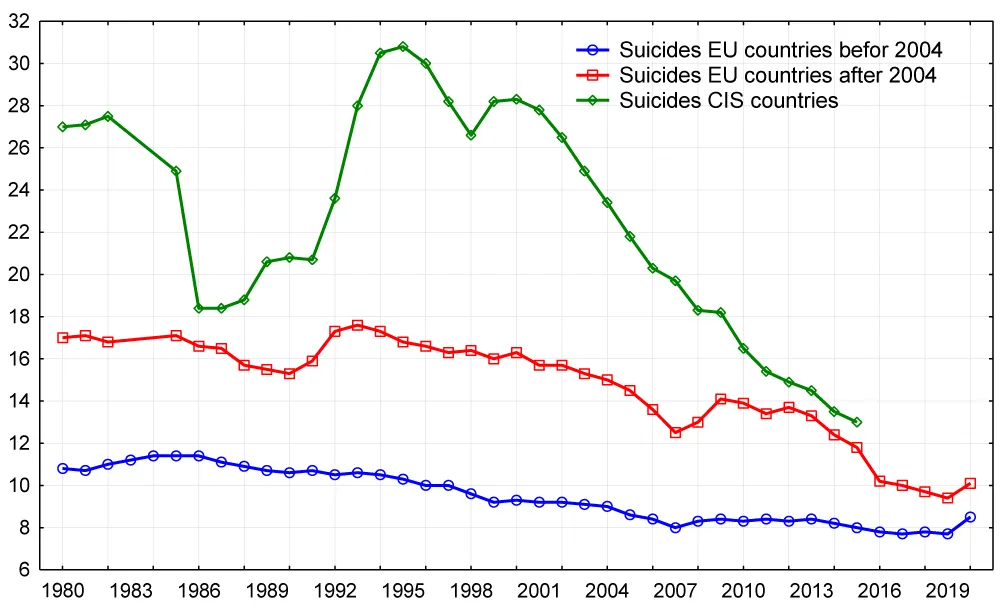
Historically, some of the highest suicide rates in the world have been recorded in countries such as Lithuania, Russia, Belarus, Latvia, and Hungary [5]. In contrast, countries in Southern and Western Europe, including Italy, Spain, Greece, and the Netherlands, generally exhibit considerably lower suicide mortality [6]. These disparities have remained relatively stable over decades despite overall declines in suicide mortality in many European populations.
The East–West gradient became particularly pronounced following the political and socioeconomic transformations associated with the collapse of the Soviet Union and the transition from centrally planned to market economies during the late 1980s and early 1990s [6,7]. The post-socialist transition was accompanied by profound social disorganization, economic instability, unemployment, income inequality, weakening of state institutions, and deterioration in public health indicators [28]. During this period, several post-Soviet countries experienced dramatic increases in suicide mortality, particularly among middle-aged men [8].
The persistence of regional disparities suggests that suicide mortality cannot be explained solely by individual psychiatric pathology. While depression, substance use disorders, and other mental illnesses remain major risk factors for suicidal behavior [9], broader social determinants play a critical role in shaping population-level suicide patterns [2,10,11]. Contemporary suicide research increasingly recognizes the importance of integrating psychiatric, sociological, economic, and cultural perspectives [6,9,12].
Among the various explanatory factors proposed for the East–West gradient, alcohol consumption has received particular attention [13-16]. Alcohol contributes to suicide risk through multiple pathways. Chronic alcohol misuse increases the risk of depression, social isolation, unemployment, family conflict, and psychiatric comorbidity [17]. Acute intoxication may further increase suicide risk by reducing inhibition, impairing judgment, and increasing impulsive behavior [18]. Countries characterized by binge drinking cultures and high spirits consumption consistently exhibit higher suicide mortality than countries where drinking patterns are more moderate and socially integrated [13,19].
One of the central findings of the literature is the strong association between alcohol consumption and suicide mortality in Eastern Europe [19-25]. This region has historically been characterized by hazardous drinking patterns, including high per capita alcohol consumption, heavy episodic drinking, preference for spirits, and widespread intoxication-oriented drinking behavior [24,25]. Several forensic studies have shown high rates of alcohol positivity among suicide victims in Eastern Europe, supporting the importance of acute intoxication in suicidal acts [23,26]. Beverage-specific analyses suggest that spirits consumption, especially vodka, is more strongly associated with suicide rates than beer or wine consumption [24]. This finding may reflect both pharmacological effects and broader cultural patterns associated with intoxication-oriented drinking. The role of alcohol appears especially important in post-Soviet societies, where episodic heavy drinking became deeply embedded in social and cultural life [14,27].
Researchers have emphasized the close temporal association between alcohol consumption and suicide mortality in post-Soviet societies. In particular, fluctuations in vodka consumption and alcohol affordability often paralleled changes in suicide rates [14,20,21]. The temporary decline in suicide mortality during the Soviet anti-alcohol campaign of the mid-1980s has frequently been cited as evidence supporting the causal importance of alcohol availability [19].
The findings also highlight the potential importance of alcohol policy as a suicide prevention strategy. Several studies suggest that reductions in alcohol availability may produce measurable declines in suicide mortality [23,26]. The Soviet anti-alcohol campaign of the mid-1980s remains one of the most frequently cited examples of population-level reductions in suicide associated with restrictive alcohol policies [26,28]. Contemporary evidence similarly suggests that increased taxation, restrictions on alcohol sales, and tighter regulation of surrogate alcohol may contribute to reductions in suicide mortality [23]. At the same time, the relationship between alcohol policy and suicide is complex. Excessively restrictive policies may increase consumption of unrecorded or surrogate alcohol in populations with entrenched hazardous drinking patterns [27]. Consequently, effective prevention strategies likely require a balanced approach integrating alcohol control with broader social and healthcare interventions.
In addition to alcohol-related factors, social integration and cultural context may contribute significantly to the East–West gradient. Classical sociological theories, particularly those developed by Émile Durkheim, emphasize the protective effects of social cohesion and collective integration [29]. The comparatively lower suicide rates observed in Southern Europe may partly reflect stronger family cohesion, religious participation, and informal support networks [2].
Differences in mental healthcare systems may also contribute to regional disparities. Western European countries generally provide broader access to psychiatric services, crisis intervention, and community-based mental healthcare [30]. In contrast, several Eastern European countries historically relied on institutional psychiatric models with limited preventive infrastructure [29]. Persistent stigma surrounding mental illness and help-seeking behavior further complicates suicide prevention efforts in many post-Soviet societies [3].
The dramatic social and economic changes that followed the collapse of the Soviet Union also appear important to understanding the East–West gradient. The post-socialist transition was associated with unemployment, declining living standards, increased inequality, migration, and weakening of social institutions [6,7]. These developments disproportionately affected middle-aged men, the demographic group with the highest suicide mortality [31]. The rapid erosion of economic security and collective social structures likely contributed to increased psychosocial stress and alcohol misuse [6,32].
Several limitations should be considered when interpreting the findings of this review. In particular, the possibility of publication bias cannot be excluded. Studies reporting significant associations between socioeconomic adversity, alcohol consumption, and suicide mortality are more likely to be published than studies with null or inconsistent findings. In addition, English-language journals may preferentially publish research from countries with established academic infrastructures, potentially limiting representation from smaller or less research-intensive European regions.
Further, the literature on East–West suicide disparities is heavily dominated by studies from post-Soviet and Baltic countries, including Russia, Belarus, Lithuania, Latvia, Estonia, and Hungary. This predominance reflects the exceptionally high suicide rates historically observed in these populations, but it may also skew the interpretation of “Eastern Europe” as a homogeneous high-risk region. Considerably fewer studies have examined suicide patterns in South-Eastern Europe, the Balkans, or Central European countries undergoing different social and economic trajectories.
The concept of an “East–West” divide may oversimplify the substantial heterogeneity that exists both within and between European regions. Suicide mortality varies markedly even among countries classified within the same geopolitical bloc. For example, suicide trends in Poland differ substantially from those in the Baltic States, while Nordic countries occupy an intermediate position between Eastern and Western Europe despite high levels of socioeconomic development. Similarly, important within-country regional disparities exist between urban and rural areas, deprived and affluent regions, and different ethnic or social groups.
Another important limitation concerns the ecological nature of much of the available evidence. Many studies relied on aggregate population-level indicators such as per capita alcohol consumption, unemployment rates, or gross domestic product. Ecological associations cannot establish causality at the individual level and may be subject to ecological fallacy. In addition, many studies examine only a limited number of determinants, most commonly alcohol consumption or economic indicators, without adequately addressing the complex interaction between social cohesion, mental healthcare accessibility, cultural norms, migration, gender inequality, and psychiatric morbidity. Relatively few studies use multidimensional analytical models capable of integrating these interconnected influences.
Cross-national comparisons are additionally complicated by differences in death certification practices, suicide registration systems, ICD coding revisions, cultural stigma surrounding suicide, and classification of undetermined deaths. Underreporting may be particularly relevant in countries where religious or social stigma toward suicide remains strong.
Finally, temporal limitations are also relevant since much of the literature focuses on the immediate post-Soviet transition period of the 1990s and early 2000s. Consequently, less is known about contemporary drivers of suicide mortality in Europe during periods characterized by economic globalization, digitalization, migration, demographic aging, and evolving alcohol consumption patterns.
Consequently, temporal comparisons should be interpreted cautiously because the social meaning of suicide, alcohol consumption patterns, mental healthcare accessibility, and economic conditions have changed considerably across Europe during the past three decades. Despite these limitations, the consistency of findings across multiple epidemiological and ecological studies suggests that substantial regional disparities in suicide mortality continue to characterize Europe and remain strongly associated with broader social and structural inequalities.
In conclusion, this review demonstrates that the East–West gradient in suicide mortality remains one of the most important and persistent epidemiological patterns in Europe. Despite substantial declines in suicide rates in many countries during recent decades, Eastern European populations continue to experience disproportionately high suicide mortality, particularly among working-age men. The evidence suggests that this gradient reflects a complex interaction between hazardous alcohol consumption, socioeconomic instability, cultural norms, political transition, and inequalities in healthcare access. The persistence of elevated suicide mortality in parts of Eastern Europe highlights the need for multifaceted prevention strategies addressing not only psychiatric disorders but also alcohol misuse, economic insecurity, social exclusion, and healthcare access.
Future research should prioritize longitudinal multicountry cohort studies, harmonized European suicide surveillance systems, standardized mortality reporting methods, analyses of within-country regional disparities, gender-specific and age-specific determinants, the role of migration and ethnic minority status, and interactions between alcohol policy, social policy, and suicide prevention strategies. Greater attention should also be devoted to protective factors, including social integration, family cohesion, religious involvement, and resilience-promoting community structures, which may help explain persistently low suicide rates in some Southern European populations. Additional comparative research may help explain why some Eastern European countries achieved substantial declines in suicide mortality while others continue to experience elevated rates. Finally, future investigations should move beyond simplistic geopolitical classifications and adopt more nuanced approaches incorporating socioeconomic development, welfare systems, cultural context, and public health infrastructure. Such approaches may provide a more comprehensive understanding of the mechanisms underlying suicide inequalities across Europe and facilitate the development of more targeted prevention policies.
References
- GBD 2021 Suicide Collaborators. Global, regional, and national burden of suicide, 1990-2021: a systematic analysis for the Global Burden of Disease Study 2021. Lancet Public Health. 2025;10:e189-e202. Available from: https://doi.org/10.1016/s2468-2667(25)00006-4
- Ping Qin, Nordentoft M. Suicide risk in relation to socioeconomic, demographic, psychiatric and familial factors. Br J Psychiatry. 2005;186:494-498.
- World Health Organization. LIVE LIFE: an implementation guide for suicide prevention in countries. Geneva: WHO; 2021. ISBN: 9789240026629. Available from: https://www.who.int/publications/b/56794
- Massimo Zuin, Diego De Leo. Suicide-related mortality trends in Europe, 2012-2021. Int J Environ Res Public Health. 2025;22:890. Available from: https://doi.org/10.3390/ijerph22060890
- World Health Organization. Suicide worldwide in 2019: global health estimates. Geneva: WHO; 2021. Available from: https://www.who.int/publications/i/item/9789240110069
- Elizabeth Brainerd. Economic reform and mortality in the former Soviet Union: a study of the suicide epidemic in the 1990s. Eur Econ Rev. 2001;45(4-6):1007-1019. Available from: https://ideas.repec.org/a/eee/eecrev/v45y2001i4-6p1007-1019.html
- William C. Cockerham. Health and social change in Russia and Eastern Europe. New York: Routledge; 1999. Available from: https://www.routledge.com/Health-and-Social-Change-in-Russia-and-Eastern-Europe/Cockerham/p/book/9780415920810
- Kairi Kõlves, Allison Milner, Peeter Värnik. Suicide rates and socioeconomic factors in Eastern European countries after the collapse of the Soviet Union. Sociol Health Illn. 2013;35(6):956-970. Available from: https://doi.org/10.1111/1467-9566.12011
- Danuta Wasserman, editor. Suicide: An Unnecessary Death. London: Martin Dunitz; 2001. Available from: https://pmc.ncbi.nlm.nih.gov/articles/PMC1120728/
- Ilkka Henrik Mäkinen. Eastern European transition and suicide mortality. Soc Sci Med. 2000;51(9):1405-1420. Available from: https://doi.org/10.1016/s0277-9536(00)00105-2
- Motunrayo Oyesanya, Lopez-Morinigo J, Dutta R. Systematic review of suicide in economic recession. World J Psychiatry. 2015;5(2):243-254. Available from: https://doi.org/10.5498/wjp.v5.i2.243
- David Lester. Suicide and unemployment in Eastern Europe. Psychol Rep. 1998;82(3):1000-1002. Available from: https://doi.org/10.2466/pr0.1994.75.1.602
- Jonas Landberg. Alcohol and suicide in Eastern Europe. Drug Alcohol Rev. 2008;27(4):361-373. Available from: https://doi.org/10.1080/09595230802093778
- Alexander V. Nemtsov. Suicides and alcohol consumption in Russia, 1965-1999. Drug Alcohol Depend. 2003;71(2):161-168. Available from: https://doi.org/10.1016/s0376-8716(03)00094-2
- Yury E. Razvodovsky, Siarhei V. Kandrychyn. Alcohol as a potential predictor of East-West gradient in the suicide rates in Europe. Clin Med Microbiol. 2025;1(1):1-3. Available from: https://asrjs.com/pdfs/alcohol-as-a-potential-predictor-of-eastwest-gradient-in-the-suicide-rates-in-europe-267.pdf
- Yury E. Razvodovsky, Siarhei V. Kandrychyn. Regional specificity of the relationship between alcohol and suicide in Europe. J Anxiety Depress. 2025;8(1):173. Available from: https://yumedtext.com/article/regional-specificity-of-the-relationship-between-alcohol-and-suicide-in-europe
- Ingeborg Rossow. Alcohol and suicide: beyond the link at the individual level. Addiction. 1996;91(10):1413-1416. Available from: https://doi.org/10.1111/j.1360-0443.1996.tb02240.x
- Leo Sher. Alcohol consumption and suicide. QJM. 2006;99(1):57-61. Available from: https://doi.org/10.1093/qjmed/hci146
- Yury E. Razvodovsky. Alcohol consumption and suicide rates in Russia. Suicidology Online. 2013;4:124-132.
- William A. Pridemore, Chamlin MB. A time-series analysis of the impact of heavy drinking on homicide and suicide mortality in Russia. Addiction. 2006;101(12):1719-1729. Available from: https://doi.org/10.1111/j.1360-0443.2006.01631.x
- William A. Pridemore. Heavy drinking and suicide in Russia. Soc Forces. 2006;85:413-430. Available from: https://doi.org/10.1353/sof.2006.0138
- Mats Ramstedt. Alcohol and suicide in 14 European countries. Addiction. 2001;96:59-75. Available from: https://doi.org/10.1080/09652140020021189
- Yury E. Razvodovsky. Alcohol consumption and suicide rate in Belarus. Psychiatr Danub. 2006;18(Suppl 1):64.
- Yury E. Razvodovsky. Beverage-specific alcohol sales and suicide rates in Russia. J Environ Public Health. 2011;2011:253409.
- Yury E. Razvodovsky. The effect of beverage type on suicide rate in Russia. J Addict Res Ther. 2014;5:181. Available from: https://pubmed.ncbi.nlm.nih.gov/22075739/
- Airi Värnik, Wasserman D, Dankowicz M, Eklund G. Age-specific suicide rates in the Slavic and Baltic regions of the former USSR during perestroika, in comparison with 22 European countries. Acta Psychiatr Scand. 1998;34:20-25. Available from: https://doi.org/10.1111/j.1600-0447.1998.tb10761.x
- Alexander V. Nemtsov, Yury E. Razvodovsky. Alcohol situation in Russia and Belarus. J Addict Res Ther. 2016;7:281.
- Alexander Stickley, Leinsalu M, Andreev E, Razvodovsky YE, Vågerö D, McKee M. Alcohol poisoning in Russia and the countries in the European part of the former Soviet Union, 1970-2002. Eur J Public Health. 2007;17(5):444-449. Available from: https://doi.org/10.1093/eurpub/ckl275
- Émile Durkheim. Suicide: A Study in Sociology. New York: Free Press; 1951.
- J. John Mann, Apter A, Bertolote J, Beautrais A, Currier D, Haas A, et al. Suicide prevention strategies: a systematic review. JAMA. 2005;294(16):2064-2074. Available from: https://doi.org/10.1001/jama.294.16.2064
- Siarhei V. Kandrychyn, Yury E. Razvodovsky. The spatial regularities of violent mortality in European Russia and Belarus: ethnic and historical perspective. J Psychiatry. 2015;18:305.
- Naghavi M. Global, regional, and national burden of suicide mortality 1990 to 2016: systematic analysis for the Global Burden of Disease Study 2016. BMJ. 2019;364:l94. Available from: https://doi.org/10.1016/s2468-2667(25)00006-4
Advertisement



 Save to Mendeley