Global Journal of Medical and Clinical Research Articles
Frequency Distribution of ABO Blood Group and Rh Factor among the Third Gender in Bangladesh
1Department of Surgery and Theriogenology, Sylhet Agricultural University, Sylhet-3100, Bangladesh
2Department of Epidemiology and Public Health, Sylhet Agricultural University, Sylhet-3100, Bangladesh
3Department of Animal and Fish Biotechnology, Sylhet Agricultural University, Sylhet-3100, Bangladesh
4Govt. College of Applied Human Science, University of Dhaka, Dhaka-1000, Bangladesh
5Department of Chemistry, National University, Gazipur-1704, Bangladesh
6Laboratory of Wildlife Resources, Gifu University, Gifu 501-1193, Japan
7Department of Medicine, Sylhet Agricultural University, Sylhet-3100, Bangladesh
#Equal 1st Author Contribution
Author and article information
Md. Mahfuzul Haque, (MS, DVM), Assistant Professor, Department of Surgery and Theriogenology, Faculty of Veterinary, Animal and Biomedical Sciences, Sylhet Agricultural University, Sylhet-3100, Bangladesh, E-mail: [email protected]
Cite this as
Sad AA, Islam MK, Chowdhury Nowfel MBU, Rahman Mim SE, Mukta MP, Rahman MM, et al. Frequency Distribution of ABO Blood Group and Rh Factor among the Third Gender in Bangladesh. Glob J Medical Clin Case Rep. 2026:13(7):147-153. Available from: 10.17352/gjmccr.000260
Copyright License
© 2026 Sad AA, et al. This is an open-access article distributed under the terms of the Creative Commons Attribution License, which permits unrestricted use, distribution, and reproduction in any medium, provided the original author and source are credited.Abstract
Introduction: The ABO and Rhesus (Rh) blood group systems are the most clinically important blood group classifications and play a fundamental role in transfusion medicine, organ transplantation, population genetics, and disease association studies. Although the distribution of ABO and Rh blood groups has been extensively investigated in different populations, no study has reported their distribution among the third gender community in Bangladesh.
Aims: Distribution of blood groups is an essential consideration in transfusion medicine, which varies across populations, regions and ethnic groups. The frequency of Blood group have investigated by several study but none have focused on the third gender community in Bangladesh. This study aims to determine the distribution of ABO and Rh blood groups among the third gender in Sylhet, Bangladesh.
Methodology: A total of 161 third gender given blood samples voluntarily. Blood grouping was evaluated by the slide agglutination method with Anti-A, anti-B, and Anti-D sera. The entire study was conducted under the Department of Surgery and Theriogenology, Sylhet Agricultural University, Sylhet, Bangladesh.
Results: Blood group O was most frequent (40.4%), followed by B (29.8%), A (24.2%) and AB (5.6%). Rh positive was more frequent (96.3%) compared to Rh negative (3.7%) blood. Additionally, in the case of blood group and Rh factor combination, this study found an order of O (+ve) > B (+ve) > A (+ve) > AB (+ve) > O (-ve) = B (-ve) = A (-ve) > AB (-ve). As no previous study on blood group distribution among the third gender population in Bangladesh was available for comparison, the present findings were assessed alongside existing data from cisgender populations. Although slight regional variations were observed in the overall distribution patterns, the predominance of blood group O and Rh-positive individuals remained consistent with findings reported in cisgender studies across different regions of Bangladesh and neighbouring countries. These results provide the first documented insight into the ABO and Rh blood group distribution among the third gender population in the Sylhet district of Bangladesh. Conclusion: The findings contribute to understanding the genetic structure and allelic frequency patterns within this underrepresented group. Moreover, they hold potential implications for transfusion medicine, population genetics, and public health planning, particularly in developing inclusive healthcare services that address the biological and social dimensions of the third gender community. Further studies could help to identify allelic variations with possible evolutionary influences on blood group frequencies of the third gender.
Introduction
Blood is a vital fluid tissue composed of plasma and cellular elements, collected and processed for therapeutic use in transfusion medicine. To support or restore physiological processes, it can be divided into components or transfused as whole blood [1]. Blood is composed of three types of cells: RBCs, WBCs, and platelets. RBC is popular for another important thing, which is the possession of about 700 blood group antigen those can be detected by 35 different systems [2]. Among them, the ABO blood grouping system is the fourth discovered and second clinically most important system (Salam, 2013), mostly used for safer blood transfusion [3]. ABO blood grouping system was first discovered in 1900 by Karl Landsteiner, and the Rh factor was discovered by Landsteiner and Weiner in 1937 [4]. According to the ABO blood grouping system, there are four different blood groups. A, B, AB, and O, and according to the presence of the Rh factor, those four blood groups can be further divided into two categories: Rh-positive and Rh- negative.
Frequencies of blood groups vary from place to place, region to region, even among populations of the same places. Several studies have been reported to find out the blood group frequencies of South-East Asia, especially the Indian Subcontinent. Blood group frequency also varies between males and females. A, B, and AB are now the next most common blood types in the world after O [5]. Rahman M. published the first blood grouping report for Bangladesh in 1975 [6], noting that blood type B was the most common. While some research indicated that type O was the most common [7,8], others indicated that blood type B was more prevalent [9,10]. Blood type A predominance was also discovered in a study of Bangladeshi tribal people [11]. A single case study of the most uncommon Bombay blood type was published in 2010 [12]. The majority of the research in Bangladesh was conducted in Dhaka [7,10], Chattogram [9], Dinajpur [8], Rangamati [11], and among the Sylhet tribals [13].
Though the blood donation practice of third-gender males and females is not that common in comparison to cisgender donors, some reports have been found about blood donation tendency among them [14]. But no study has reported the frequency of ABO blood groups among third gender. Several studies are showing the frequency of blood groups that only represent the cisgender population. O is the most frequent blood type globally, followed by A, B, and AB [5]. In Bangladesh, the first report of blood grouping was in 1975 by Rahman M [6], where B was the most frequent blood type. Some other studies showed a higher number of B blood types [9,10], whereas some showed type O most frequent [7,8]. Dominance of A blood type was also found in a study among the tribals of Bangladesh [11]. In 2010, a single case study of the rarest Bombay blood group was reported [12]. Several studies were found in Bangladesh, mostly in Dhaka [7,10], Chattogram [9], Dinajpur [8], Rangamati [11], and among tribals of Sylhet [13]. However, no study was found on the third gender in Sylhet district in Bangladesh. Therefore, the current study aims to find out the frequencies of blood type among the third gender people of Sylhet in Bangladesh.
Material and methods
Communication with third gender
Third gender of Bangladesh remain in groups throughout the country. To communicate with the group in Sylhet, we approached one of the third gender males of Uposhahar, Sylhet. With his help, we communicated with the group leader of the Sylhet region. In January 2025, a meeting was conducted with the community leader at his residence to explain the objectives and procedures of the study. After obtaining his agreement and support, October 2025 was selected as the appropriate time for sample collection.
Area & Sample collection
As stated by the leader of the third gender of Sylhet, there are about more or less 900 third gender along with homosexuals, in Sylhet district. We invited everyone of them to attend our study sampling voluntarily. 161 of them attended and agreed to provide blood samples.
Sample collection
Third gender has been reported to be 13 times more likely to be HIV-positive than other adults (15). Considering this fact, proper and suitable safety measures were followed during blood sample collection. Gloves were used to prevent any contact with blood. Technicians who worked with us were also checked for any lacerated wounds and/or any kind of cuts on the skin. Proper social distancing was maintained to prevent transmission of COVID-19 during blood sample collection. The ring finger was selected for collection of blood. If there was any difficulty with the ring finger, the index or middle finger was used. The selected finger was washed aseptically with Hexisol (a mixture of 0.5% Chlorhexidine gluconate and 70% isopropyl alcohol). Then three drops of blood were collected on a grease-free, clean and clear glass slide by pricking with a lancet. A single glass slide was used for each sample to reduce errors.
Determination of blood groups & Rh factor
Blood groups & Rh factor were determined by the glass slide method [16]. Anti-A and Anti-B were used to determine blood group & Anti-D was used to determine the Rh factor of blood. Immediately after collection of blood. One drop of reagent from each type of (Anti-A, Anti-B, and Anti-D) antibody was placed beside the blood drop on the same glass slide. Any contact between the reagent dropper and the blood was carefully avoided. Then the blood sample and reagent were mixed thoroughly & very carefully. If only Anti-A produced a clot in the blood, blood group A was confirmed. If only Anti-B produced a clot in the blood, blood group B was confirmed. If both Anti-A and Anti-B produced a clot, blood group AB was confirmed. If no clot was produced by both Anti-A and Anti-B, blood group O was confirmed. Rh factor of the blood was also determined in the same way. If Anti-D produced a clot, Rh-positive was confirmed. If Anti-D did not produce any clot, Rh-negative was confirmed.
Data collection and analysis
All participants were briefed before data collection. Particulars of each participant were primarily noted on a paper sheet and after that transferred to a Microsoft Excel Data sheet. SPSS version 25.0 was used for statistical analysis. Descriptive statistical analysis was done by cross-tabulation of blood group and Rh factor and expressed in percentages in comparison with total observations. Gene frequency and Rh phenotypes were calculated using the Hardy-Weinberg equation. For ABO allele frequency, the Hardy-Weinberg equation states that p+q+r= 1; and if the population is in equilibrium and there is no external force (mutation, migration and selection), the second generation is expected to show (p+q+r)2= p2+q2+r2+2pq+2qr+2rp=1; where p, q, and r are allelic frequencies of A, B, and O, respectively (Mayo, 2008). Here p, q, and r are measured by the S2 ABO estimator (Silva, 2002). On the other hand, for Rh allele frequency, the Hardy-Weinberg equation states that P+Q=1, and if the population is in equilibrium, the second generation will show (P+Q)2 = P2+2PQ+Q2; where P and Q are the allelic frequencies of D and d, respectively. For calculation of P and Q, the following equation was used,
Q= 1-P [17]
The observed and expected values were analysed for goodness-of-fit X2 tests at a confidence interval of 95% by using the following equation.
Results
A total of 161 samples were collected and listed for blood group and Rh factor, and no missing values were reported. Every one of them was third gender that makes our study unique for them. In the cross-tabulation of blood group and Rh factor, we found that O is the most frequent blood group with a percentage of 40.4%, followed by B with a percentage of 29.8%, A with a percentage of 24.2%, and AB with a percentage of 5.6% (Table 1). Rh factor positive was dominant with a percentage of 96.3%, and Rh factor negative was 3.7%.
Cross tabulation also shows us O+ve was the most frequent blood group with Rh factor found among the third gender (39.1%), which is followed by B+ve (28.6%), A+ve (23.0%), AB+ve (5.6%), and A-ve, B-ve, and O-ve equally (1.2%). The frequency of AB-ve was nil. Within blood group, though Rh factor positive dominates, they vary with different percentages. Within blood group O, Rh factor positive was 96.9% & Rh factor negative was 3.1%. Similarly, within blood group B, Rh factor positive was 95.8% and Rh factor negative was 4.2%; within blood group A, Rh factor positive was 94.9% and Rh factor negative was 5.1%; and within blood group AB, all were Rh factor positive, making it 100%, as there was no individual with Rh negative within the AB blood group participated to our study.
O has the highest allele frequency (0.6354), followed by B (0.20238) and A (0.16832), according to Table 2. When it comes to the Rh factor, the Rh D allele is more common (0.96273) than the Rh d allele (0.03727).
The genThe phenotypic frequency of homozygous and heterozygous individuals is displayed in Table 3. The highest frequency is displayed by homozygous O (0.40372681), which is followed by homozygous B (0.04095685) and homozygous A (0.02833263). The highest frequency is displayed by heterozygous B (0.25717994), which is followed by heterozygous A (0.21390319) and heterozygous AB (0.06812974). Nonetheless, the most common genotype is homozygous Rh+ve (DD) (0.92685483), which is followed by heterozygous Rh+ve (Dd) (0.07175634) and homozygous Rh-ve (dd) (0.00138883).
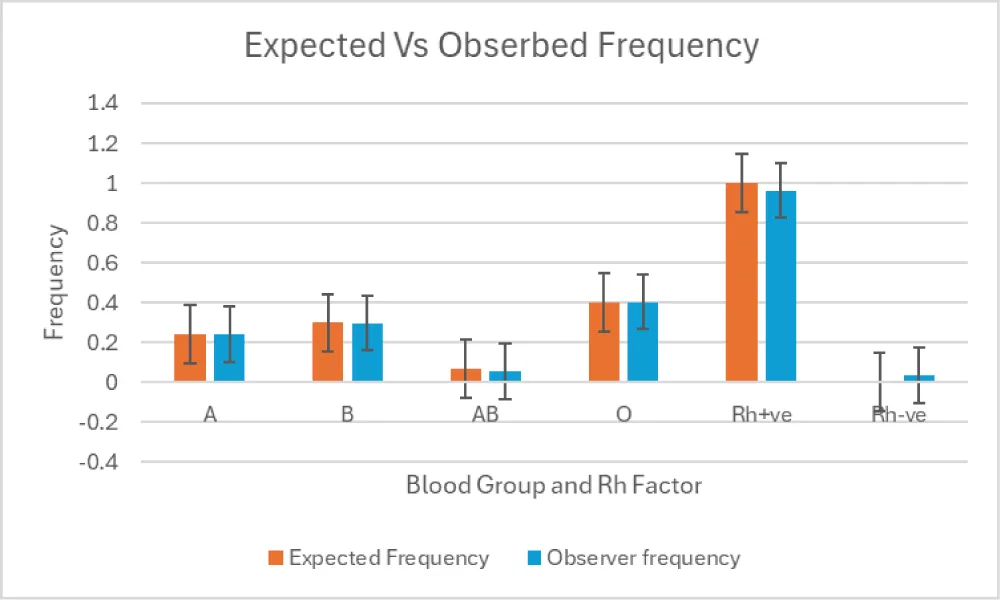
Table 4 shows the highest phenotypic frequency of group O (0.403726806) and Rh+ve (0.998611171) in the Rh system. The second generation, according to the Hardy-Weinberg equation, (p + q + r)2 = p2+ q2 + r2 + 2pq +2pr + 2qr = 1. The summation of our findings is equal to 1, which shows that the population is in equilibrium. The difference between observed and expected blood group frequency from our study is not statistically significant (p-value= 0.965026).
We compared the current findings with cisgender data (Figure 1). The observed distribution among third gender appeared to follow the expected genetic proportions, as indicated by the tight alignment found between the expected and observed frequencies of ABO and Rh blood groups across the majority of categories. The results indicated that there were only a few differences between the expected and observed values for the frequencies of blood types A, B, AB, and O, with O continuing to be the most common group. In line with broader population trends, Rh-positive people also displayed a noticeably higher frequency than Rh-negative people. Localised genetic drift among the third gender community under study or sample size constraints could be the cause of the minor differences seen. Overall, the findings support the Hardy–Weinberg assumptions by showing that the population maintains a stable genetic equilibrium for the ABO and Rh systems.
Discussion
From our study, it was found that O was the most frequent blood group, followed by B, A, and AB. There was no similar study was found about the third gender in Google Scholar & PubMed. From the results of our study, O was the most available blood group & AB was the least available blood group, which is similar to worldwide available studies. The order of blood group found by this study is O>B>A>AB, which is similar to a study found in Bangladesh [8,18-20], India [21-23], and Pakistan [24,25]. Though all studies show dominance of the O blood group, our study differs from the most common blood group order (O>A>B>AB) both internationally [2,3,26-28]. Few studies from Bangladesh also show the same order [8,19].
Most of the studies found in the South-East Asian region show a different order of blood groups, where B is the most frequent blood group, and AB is the least frequent, making the order B>O>A>AB. Several studies have been reported in Bangladesh [9-11,26], India [19,22,29-32], and Pakistan [33]. Few studies found a different order with a dominance of blood group B [34,35]. However, one study found dominance of blood group A, where Sharif et. al. [36] found the order A>B>O>AB, and a couple of studies [13,37] found the order A>O>B>AB. Dominance of AB was not reported by any study, as in ours. Based on Rhesus factor, our study shows that Rh+ has the highest percentage (96.3%) compared to Rh- (3.7%), which is similar to all the studies available, along with studies of the Sylhet region [13]. Though dominance of Rh+ was confirmed, our study differs in percentage.
In the case of blood group & Rh factor combined, our study shows an order of O+ve> B+ve > A+ve>AB+ve >A-ve= B-ve= O-ve > AB-ve, which seemed to be a little bit biased due to a smaller sample size. One explanation of this can be that our subjects only include third-gender individuals, and there is a small willingness from them. The first portion of our study order (O+ve> B+ve > A+ve>AB+ve) is supported by some studies [7,22]. Further study with a higher sample size can be conducted to remove the bias and find out the actual status of ABO blood group and Rh factor status of the third gender of Bangladesh. Allelic frequency in this study showed A=0.16832; B=0.20238, and O= 0.6354 (O>B>A), which is similar to the findings of Dewan [11] and a couple of Nigerian studies [38]. Our sequence varies with some findings from Nigeria also [30,39], where A is larger than B. Rh+ve shows dominance over Rh-ve all over the world, which is also found in this study with a percentage of 96.3% and allele frequency of 0.96273. Other studies of Bangladesh showed similar results but with a different frequency [11].
Our study result is similar to some of the international studies, such as in India [40] and the United States [41]. However, Rh-ve was found to be as low as 0.69% in one of the studies in India [42]. Our study also confirms the Hardy-Weinberg law while gene frequency is determined. The sum of the frequencies of different homozygous and heterozygous genes is 1, which means the population is in equilibrium. There was only one study found in Bangladesh determining the gene frequency of the ABO blood group. The order found by our study (OO>BO>AO>AB>BB>AA) shows similarity with some international studies. The order of gene frequency of the Rh system found by our study is DD>Dd>dd, which is similar to all available studies in the world. But our study result varies from Gourav Dewans’ study findings, which are 0.4591, 0.4367 and 0.1038, respectively. According to the Hardy-Weinberg law, for the second generation, our study confirms that both ABO blood group and Rh factor are in equilibrium. The chi-squared test shows that there is no significant statistical difference between expected and observed values (p-value=0.965026).
This study has several limitations that should be considered when interpreting the findings. First, the cross-sectional design provides a snapshot of the distribution of ABO blood groups and Rh factor among the third-gender population and does not permit causal inferences or assessment of temporal changes. Second, participants were recruited using non-probability sampling due to the difficulty in accessing this marginalised population. Third, the study was conducted in Sylhet only; therefore, the findings may not be generalizable to all third-gender communities across the country. In addition, the study focused solely on the distribution of ABO and Rh blood groups and did not evaluate genetic, demographic, or clinical factors that may influence blood group frequencies. Despite these limitations, the study provides valuable baseline data on the distribution of ABO blood groups and Rh factor among the third-gender population in Bangladesh, a group for which such information has been largely unavailable.
Conclusion
Rh factor and blood group frequency vary across and between various racial and ethnic groupings as well as within the same geographic region. Our study aimed to determine the current state of blood group frequency only among the third gender in the Sylhet district. As no previous studies have investigated the distribution of ABO blood groups and Rh factor among the third-gender population, our findings were compared with published data from the cisgender population in Bangladesh and neighbouring countries, despite minor regional variations. Blood group O (40.4%) and Rh-positive status (96.3%) were the most prevalent, with an overall distribution pattern comparable to that reported in cisgender populations despite minor regional variations. Although slight regional variations were observed, the predominance of blood group O and Rh-positive individuals was consistent with findings reported in cisgender populations across Bangladesh and neighbouring countries. Our study may have practical implications in the field of transfusion medicine, blood donor management, population genetics, and public health platforms by supporting the improvement of healthcare services for the third-gender community. Future experiments with larger sample sizes and molecular genetic analyses are recommended to evaluate these findings and provide further insights into the allelic variations and evolutionary factors underlying blood group frequencies in the third-gender population.
Acknowledgements
We acknowledge the contribution of ‘BADHAN’ (A Voluntary Blood Donors’ Organisation), Sylhet Agricultural University Unit, for their amicable support and technical help. We are also grateful for the contribution and participation of every third gender in our study.
Competing interests
The authors declare that they have no competing interests relevant to this manuscript.
Authors’ contributions
Abdullah Al Sad - Data curation, Formal analysis, methodology, writing original draft, writing- review and editing; Md. Khademul Islam- Data curation, formal analysis, methodology, writing original draft; Md. Burhan Uddin Chowdhury- Investigation, methodology, validation; Saima Effath Rahman Mim- Investigation, methodology, validation; Munira Parvin Mukta - Investigation, methodology, validation; Mahia Islam- Investigation, methodology, validation; Md. Mahfuzul Haque – Conceptualisation, investigation, methodology, supervision, writing- review and editing; Md. Matiur Rahman - Conceptualisation, formal analysis, investigation, methodology, supervision, writing- review and editing.
Ethical approval
The study was conducted according to the ethical guidelines of the ethical committee of Sylhet Agricultural University (approval number: ARP2025035).
References
- Alimov N. Blood supply to the human body, vascular anatomy and blood components. West Eur J Med Med Sci. 2023;1(4):4-14. Available from: https://westerneuropeanstudies.com/index.php/3/article/view/119
- Golassa L, Tsegaye A, Erko B, Mamo H. High rhesus (Rh[D]) negative frequency and ethnic-group based ABO blood group distribution in Ethiopia. BMC Res Notes. 2017;10(1):330. Available from: https://doi.org/10.1186/s13104-017-2644-3
- Iyiola O, Igunnugbemi O, Bello O. Gene frequencies of ABO and Rh(D) blood group alleles in Lagos, South-West Nigeria. Egypt J Med Hum Genet. 2012;13(2):147-153. Available from: https://doi.org/10.1016/j.ejmhg.2011.08.006
- Landsteiner K, Wiener AS. An agglutinable factor in human blood recognized by immune sera for rhesus blood. Proc Soc Exp Biol Med. 1940;43(1):223-224.
- Storry JR, Olsson ML. The ABO blood group system revisited: a review and update. Immunohematology. 2009;25(2):48-59. Available from: https://pubmed.ncbi.nlm.nih.gov/19927620/
- Rahman M. Incidence of important blood groups in Bangladesh. Bangladesh Med Res Counc Bull. 1975;1(1):60-63. Available from: https://pubmed.ncbi.nlm.nih.gov/1244016/
- Akhter S, Kibria GM, Akhter N, Habibullah MM, Islam SMJ, Zakariah MM. ABO and Lewis blood grouping with ABH secretor and non-secretor status: a cross-sectional study in Dhaka. Faridpur Med Coll J. 2011;6(1):38-40. Available from: https://doi.org/10.3329/fmcj.v6i1.7409
- Talukder SI, Das RK. Distribution of ABO and Rh blood groups among blood donors of Dinajpur district of Bangladesh. Dinajpur Med Coll J. 2010;3(2):55-58.
- Zaman R, Parvez M, Jakaria M, Sayeed MA. Study of ABO and Rh-D blood group among the common people of Chittagong City Corporation area of Bangladesh. J Public Health Epidemiol. 2015;7(9):305-310. Available from: https://doi.org/10.5897/JPHE2015.0727
- Sultana R, Rahman Z, Helali A, Yousuf R, Mustafa S, Salam A, et al. Study of ABO and Rh-D blood groups among the common people of the capital city of Bangladesh. Int J Pharm Pharm Sci. 2013;5(3):814-816.
- Dewan G. Comparative frequency and allelic distribution of ABO and Rh(D) blood groups of major tribal communities of southern Bangladesh with the general population and their determinants. Egypt J Med Hum Genet. 2015;16(2):141-147. Available from: https://doi.org/10.1016/j.ejmhg.2015.01.002
- Banu T, Ali S. Rarest of rare Bombay blood group in Bangladesh: a case report. J Bangladesh Soc Anaesthesiol. 2010;23(1):34-36. Available from: https://doi.org/10.3329/jbsa.v23i1.18157
- Begum D, Amin MN, Khatun F, Ahmed S, Sinha S, Rahman M. Distribution of ABO and Rh blood groups among tribal population of Sylhet, Bangladesh. J Dhaka Med Coll. 2011;20(1):44-50. Available from: https://doi.org/10.3329/jdmc.v20i1.8581
- Goldman M, Butler-Foster T, Lapierre D, O’Brien SF, Devor A. Trans people and blood donation. Transfusion. 2020;60(5):1084-1092. Available from: https://doi.org/10.1111/trf.15777
- World Health Organization. Consolidated guidelines on HIV, viral hepatitis and STI prevention, diagnosis, treatment and care for key populations. Geneva: World Health Organization; 2022.
- Malomgré W, Neumeister B. Recent and future trends in blood group typing. Anal Bioanal Chem. 2009;393(5):1443-1451. Available from: https://doi.org/10.1007/s00216-008-2411-3
- Mayo O. A century of Hardy-Weinberg equilibrium. Twin Res Hum Genet. 2008;11(3):249-256. Available from: https://doi.org/10.1375/twin.11.3.249
- Akter K, Khan H, Ahmed M, Karim AI, Ahmed J, Zaman MM. Distribution of blood group among pregnant women in a rural area of Bangladesh. J Xiangya Med. 2020;5:Article 5. Available from: https://jxym.amegroups.org/article/view/6736/html
- Hira R, Dhali L, Dhali N, Akash D. ABO and Rh-D blood group distribution in a rural population of Bangladesh. Mediscope. 2015;2(1):22-26. Available from: https://doi.org/10.3329/mediscope.v2i1.24736
- Rupok TA, Dey S, Bostami B. No tendencies of personality traits in blood groups: a cross-sectional study conducted on Bangladeshi people. 2021. Available from: https://doi.org/10.21203/rs.3.rs-728769/v1
- Erlanson EW. Blood-group distribution in India with special reference to Bengal. J Genet. 1938;36(2):225-237.
- Rao C, Shetty J. Frequency of ABO and rhesus (D) blood groups in Dakshina Kannada district of Karnataka: a study from a rural tertiary care teaching hospital in South India. J Health Allied Sci NU. 2014;4(3):57-60. Available from: https://doi.org/10.1055/s-0040-1703802
- Sachdev B. Incidence of ABO and Rh(D) blood groups among Banjara, a nomadic group of Rajasthan, India. Anthropologist. 2012;14(1):87-88. Available from: https://doi.org/10.1080/09720073.2012.11891225
- Ahmed M, Memon AS, Iqbal K. Distribution pattern of ABO and Rhesus blood groups among different ethnic populations of Karachi. J Pak Med Assoc. 2019;69(10):1474-1478. Available from: https://pubmed.ncbi.nlm.nih.gov/31622300/
- Khan MS, Farooq N, Qamar N, Tahir F, Subhan F, Kazi BM, et al. Trend of blood groups and Rh factor in the twin cities of Rawalpindi and Islamabad. J Pak Med Assoc. 2006;56(7):299-302. Available from: https://pubmed.ncbi.nlm.nih.gov/16900708/
- Dipta TF, Iqbal MR, Hossain AZ, Rahman MT, Chowdhury S. Distribution of phenotypic and genotypic ABO and Rhesus blood groups among Bangladeshi population. Ibrahim Med Coll J. 2011;5(2):59-62. Available from: https://doi.org/10.3329/imcj.v5i2.10101
- Hussain R, Fareed M, Shah A, Afzal M. Prevalence and gene frequencies of A1A2BO and Rh(D) blood group alleles among some Muslim populations of North India. Egypt J Med Hum Genet. 2013;14(1):69-76. Available from: https://doi.org/10.1016/j.ejmhg.2012.06.001
- Saleh SM, Abood AS. ABO and Rh(D) blood groups’ distribution and gene frequencies in North Baghdad population, Iraq. Int J Sci Eng Res. 2016;7:2-4.
- Agarwal N, Thapliyal RM, Chatterjee K. Blood group phenotype frequencies in blood donors from a tertiary care hospital in North India. Blood Res. 2013;48(1):51-54. Available from: https://doi.org/10.5045/br.2013.48.1.51
- Chandra T, Gupta A. Prevalence of ABO and rhesus blood groups in Northern India. J Blood Disord Transfus. 2012;3(5):132. Available from: https://doi.org/10.4172/2155-9864.1000132
- Choudhury P, Chakrabarti JS, Chowdhury PS. Frequency and distribution of blood groups in tribal blood donors of Tripura. J Med Soc. 2016;30(3):158-161.
- Sidhu S. Distribution of the ABO blood groups and Rh(D) factor among the scheduled caste population of Punjab. Anthropologist. 2003;5(3):203-204. Available from: https://doi.org/10.1080/09720073.2003.11890806
- Khattak ID, Khan TM, Khan P, Shah SMA, Khattak ST, Ali A. Frequency of ABO and Rhesus blood groups in District Swat, Pakistan. J Ayub Med Coll Abbottabad. 2008;20(4):127-129. Available from: https://pubmed.ncbi.nlm.nih.gov/19999224/
- Murtaza M, Ali MN, Zargar MH. Allele frequency of ABO and Rh(D) blood group system among the ethnic students of Ladakh, India. Uttar Pradesh J Zool. 2020;41(4):39-42.
- Nazli R, Haider J, Khan MA, Akhtar T, Aslam H. Frequency of ABO blood groups and RhD factor in the female population of District Peshawar. Pak J Med Sci. 2015;31(4):984-986. Available from: https://doi.org/10.12669/pjms.314.6640
- Sharif S, Anwar N, Farasat T, Naz S. ABO blood group frequency in ischemic heart disease patients in Pakistani population. Pak J Med Sci. 2014;30(3):593-597. Available from: https://doi.org/10.12669/pjms.303.4502
- Singh B. Distribution of ABO blood groups and rhesus factor percentage frequencies amongst the populations of Sikkim, India. Proc Indian Natl Sci Acad. 2017. Available from: https://insa.nic.in/writereaddata/UpLoadedFiles/PINSA/2017_Art04.pdf
- Falusi AG, Ademowo OG, Latunji CA, Okeke AC, Olatunji PO, Onyekwere TO, et al. Distribution of ABO and RH genes in Nigeria. Afr J Med Med Sci. 2000;29(1):23-26. Available from: https://pubmed.ncbi.nlm.nih.gov/11379462/
- Khalil I, Phrykian S, Farr A. Blood group distribution in Sudan. Gene Geogr. 1989;3(1):7-10. Available from: https://pubmed.ncbi.nlm.nih.gov/2518630/
- Giri PA, Yadav S, Parhar GS, Phalke DB. Frequency of ABO and rhesus blood groups: a study from a rural tertiary care teaching hospital in India. Int J Biol Med Res. 2011;2(4):988-990. Available from: https://www.biomedscidirect.com/download/IJBMRF2011333/13/frequency-of-abo-and-rhesus-blood-groups-a-study-from-a-rural-tertiary-care-teaching-hospital-in-india.pdf
- Garratty G, Glynn SA, McEntire R; Retrovirus Epidemiology Donor Study. ABO and Rh(D) phenotype frequencies of different racial/ethnic groups in the United States. Transfusion. 2004;44(5):703-706. Available from: https://doi.org/10.1111/j.1537-2995.2004.03338.x
- Reddy BC, Reddy CS. ABO and Rh(D) blood group distribution among Voddes, a backward caste population of Andhra Pradesh. Anthropologist. 2005;7(3):235-236. Available from: https://krepublishers.com/02-Journals/T-Anth/Anth-07-0-000-000-2005-Web/Anth-07-3-161-236-2005-Abst-PDF/Anth-07-3-235-236-2005-264-Reddy-B-K-C/Anth-07-3-235-236-2005-264-Reddy-B-K-C-Full-Text.pdf
Advertisement


 Save to Mendeley