Global Journal of Medical and Clinical Case Reports
CCK-2/Gastrin-R Immunodistribution in a Solid Pseudopapillary Pancreatic Tumor: A Case Report of a 28-Years-Old North African Woman
Author and article information
Cite this as
Sellam F, Harir N, Mrabent NM, Tou A, Belkralladi H, et al. (2016) CCK-2/Gastrin-R Immunodistribution in a Solid Pseudopapillary Pancreatic Tumor: A Case Report of a 28-Years-Old North African Woman. Global J Med Clin Case Reports 3(1): 015-017. DOI: 10.17352/2455-5282.000026
Copyright License
© 2016 Sellam F, et al. This is an open-access article distributed under the terms of the Creative Commons Attribution License, which permits unrestricted use, distribution, and reproduction in any medium, provided the original author and source are credited.Introduction
Solid Pseudopapillary Tumor (SPT) of the pancreas is a very rare entity with a reported incidence of 0.13% to 2.7% of all pancreatic tumors [1], this tumor was once described in many other terms, such as Frantz’s tumor, solid and cystic tumor, papillary cystic neoplasm, and solid and papillary epithelial neoplasm [2].
It is almost exclusively seen in females and occurs in the second or third decades of life [3], suggesting that this tumor is associated with some female hormones and their receptors such as estrogen, progesterone and opioids [4,5]. Several lines of evidence support the role of G protein-coupled receptor cholecystokinin 2 and gastrin (CCK-2R/gastrin-R) in pancreatic cancer development [6,7].
In order to study immunohistochemical features of G protein coupled CCK2/gatrin receptors in this kind of rare tumors, we herein present a case of solid pseudopapillary pancreatic tumor associated with a positive CCK-2/gastrin-R reactivity.
Case Report
A 28-year-old North African woman with no prior medical or surgical history presented with complaints of epigastric and right upper quadrant (RUQ) pain and decreased appetite during one month. Her pulse rate was 72 min-1 and her blood pressure was 110/60 mmHg. There was no precipitating or aggravating factor and no evidence of jaundice. On physical examination her abdomen was soft, non-tender and non-distended; there were no palpable masses and bowel sounds were audible. Other physical examinations were unremarkable. Laboratory data including hematology, blood chemistry including amylase and lipase, as well as tumor markers were within the reference limits (CEA = 0.692 ng/ml, CA 125 = 12.27 Ul/ml, and CA 19-9 = 22.59 Ul/ml).
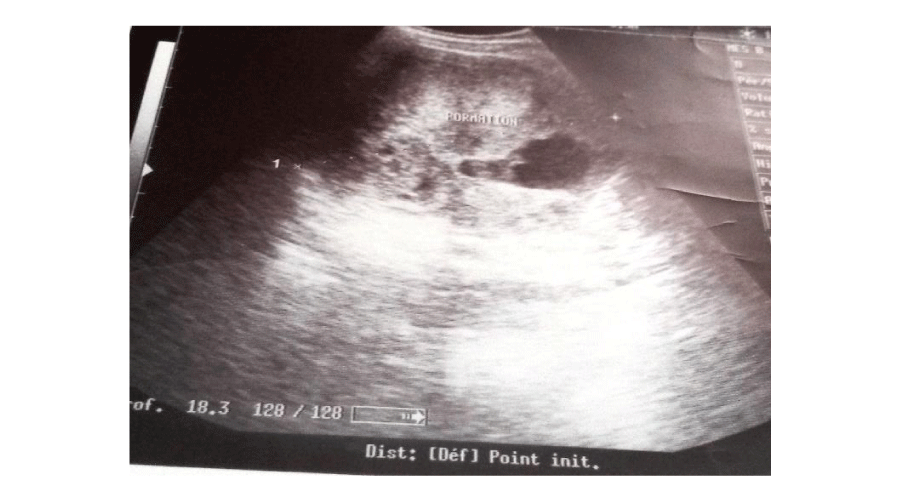
Ultrasound imaging (Figure 1) showed a solid heterogeneous mass at the level of left quadrant measuring 124 mm.
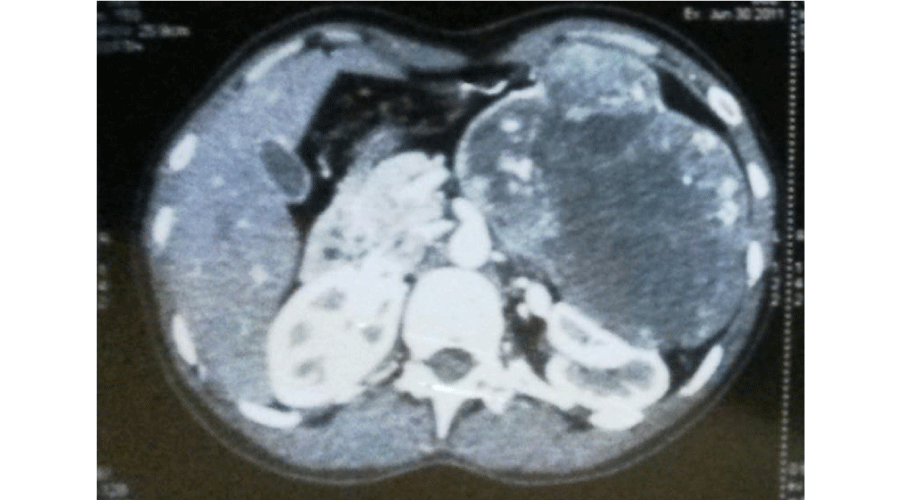
CT scan of the abdomen (Figure 2) revealed a voluminous hypoattenuating mass in the tail and the body of the pancreas, measuring 127mm x 87mm with multiple intratumoral vessels.
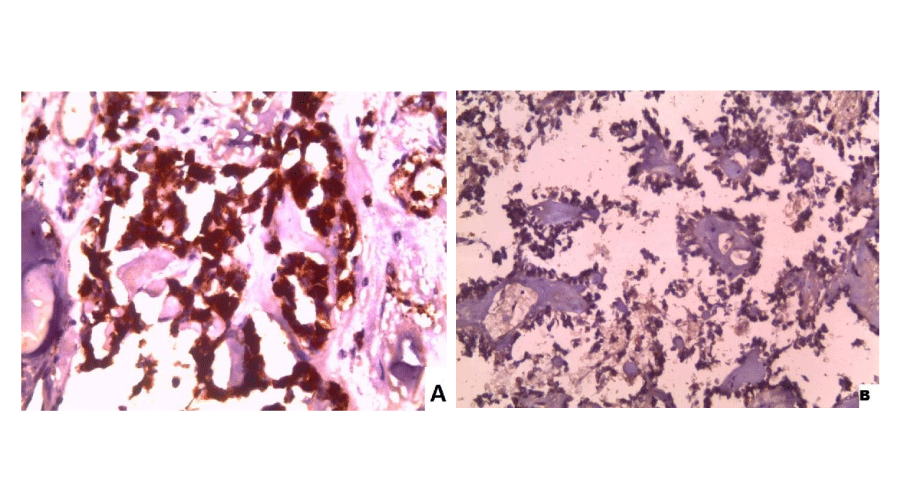
After a surgical biopsy was performed; histological examination demonstrated a solid pattern with non infiltrant pseudopapillary cores; the tumor was found to be confined to the pancreas (Figure 3). Our immunohistochemical analysis revealed that the tumor cells were positive for CCK-2/gastrin receptors that were highly expressed within the cytoplasmic area of the cells. (Figure 3). The next strategy for patient treatment was chemotherapy.
Discussion
Solid pseudopapillary tumors of the pancreas affect primarily young women, suggesting that hormonal factors contribute to the tumor growth [4,5,8]. In the current study, symptoms were reported at a woman of 28 years of age, an age at which female hormones and their receptors such as progesterone, estrogen are very active and might play a role in the development of solid pseudopapillary tumor of the pancreas [9,10].
Pancreatic cancer risk was elevated in women with early age at menarche, as noted previously [11,12], sex steroid receptors in normal and neoplastic pancreatic tissue have been found in animals and in humans [13,14]; the incidence of pancreatic cancer is lower in female than in male rodents [15], and estrogens and/or castration have an inhibitory effect on the early stages of pancreatic carcinogenesis [16].
Some epidemiological studies have assessed the role of hormone-related factors in the etiology of pancreatic cancer [11,12].
The exact cell of origin is still disputed [17], the strong female predilection [18,19] and the reported expression of progesterone receptors in some SPT cases [20], may suggest an association between female sex hormones and tumorigenesis, but a causal relationship has not been definitively proven. Yeh et al., have reported that the progesterone receptor is uniquely expressed in solid pseudopapillary tumors while both estrogen and progesterone receptors are expressed in mucinous cystic neoplasm [21].
Zamboni et al. [22], attempted to give an explanation about pancreatic tumors that affect women by stating that pancreatic anlages are very close to the genital ridge during embryogenesis. Primitive ovarian tissue may be incorporated into pancreatic tissue during the process of pancreatic fusion, after which dislocated ovarian tissue may start growing in response to female hormones during adolescence. Indeed, immune-profiles of pancreatic tumors which affect women are similar to those in certain ovarian tumors [22,23].
Our case showed that pancreatic tumor cells were positive to CCK-2R/gastrin-R according to our immunohistochemical study. Several studies has shown that CCK-2R/gastrin-R are present in pancreatic tumor cell lines and that exogenous administration of CCK to pancreatic cancer cells stimulates growth [24-26], however the role of CCK as an autocrine growth regulator in pancreatic cancer has not been examined.
In addition, it was reported in Elas-CCK2 transgenic mice, expressing functional human CCK-2R in pancreatic exocrine cells, an increased pancreatic growth, an acinar to ductal trans-differentiation, postulated to be a preneoplastic step in pancreatic carcinogenesis and the development of tumours [27,28].
We may explain the important rate of CCK-2R/gastrin-R in the solid pseudopapillary pancreatic tumor especially in young women by the interaction between cholecystokinin and female hormones; mainly estrogen and opioids.
Micevych et al., concluded that estrogen plays the role of a powerful regulator over the expression of CCK after the results of their studies showed that estrogen reduces CCK binding within 24 hr of treatment. The same research team have examined as well the estrogen modulation and its interactions in the hypothalamus and limbic system where opioids exert a dual regulation on the release and expression of CCK to modulate reproductive behavior and found that CCK-opioids reciprocal interactions modulated by estrogen state influence the response of mammals to stimuli altering reproduction, memory/learning and perception of pain in case one of those hormones is deregulated [29].
In summary, referring to our results and those of Micevych et al. [29], Zamboni et al. [22], Matters et al. [26] Yeh et al. [21], we may raise the following hypothesis: Solid pseudopapillary tumors of the pancreas affect mostly young women at an age when female hormones and their receptors are very active [9], however; unlike progesterone; estrogen was not found to be expressed in solid pseudopapillary pancreatic tumors [21,30,31], knowing that there are no doubt estrogen receptors and estrogen-binding protein are expressed in human healthy pancreas [32]. Estrogen represents as well a powerful regulator of the expression of CCK since it decreases cholecystokinin binding [29]. Thus if estrogen is down regulated; CCK binding would increase; and CCK-2/gastrin receptors would be overexpressed; and as Matters et al. reported this may lead cholecystokinin to play the role of a growth factor for human pancreatic cancer [26].
Conclusion
Solid pseudopapillary pancreatic tumors cells overexpress G protein coupled CCK-2/gastrin receptors that could be very interesting biomarkers for SPT diagnosis and target therapies.
Acknowledgments
The authors would like to thank the members of pathology department of Sidi bel Abbes hospital for their invaluable support, guidance, and educational insight.
References
- Crawford BE 2nd (1998) Solid and papillary epithelial neoplasm of the pancreas, diagnosis by cytology. South Med J 91: 973-937.
- Cheng DF, Peng CH, Zhou GW, Tao ZY, Chen X, et al. (2005) Clinical misdiagnosis of solid pseudopapillary tumour of pancreas. Chin Med J 118: 922-926.
- Oliveira Lima S, Rocha Santana V, Correia Leao S, Faro Santos PS, De Alburquerque Jr RL (2012) Solid-pseudopapillary tumor of pancreas in a young woman: a case report and literature review. Rev Med Chil 140: 1179–1184.
- Mortenson MM, Katz MH, Tamm EP, Bhutani MS, Wang H, et al. (2008) Current diagnosis and management of unusual pancreatic tumors. Am J Surg 196: 100-113.
- Kallichanda N, Tsai S, Stabile BE, Buslon V, Delgado DL, et al. (2006) Histogenesis of solid pseudopapillary tumor of the pancreas: the case for the centroacinar cell of origin. Exp Mol Pathol 81: 101-107.
- Caplin M, Savage K, Khan K, Brett B, Rode J, et al. (2000) Expression and processing of gastrin in pancreatic adenocarcinoma. Br J Surg 87: 1035-1040.
- Goetze JP, Nielsen FC, Burcharth F, Rehfeld JF (2000) Closing the gastrin loop in pancreatic carcinoma: coexpression of gastrin and its receptor in solid human pancreatic adenocarcinoma. Cancer 88: 2487-2494.
- Kang CM, Choi SH, Kim SC, Lee WJ, Choi DW, et al. (2014) Predicting recurrence of pancreatic solid pseudopapillary tumors after surgical resection: a multicenter analysis in Korea. Ann Surg 260: 348-355.
- Watanabe D, Miura K, Goto T, Nanjo H, Yamamoto Y, et al. (2010) Solid Pseudopapillary Tumor of the Pancreas with Concomitant Pancreas Divisum. A Case Report, JOP 11: 45-48.
- Mauriello C, Napolitano S, Gambardella C, Candela G, De Vita F, et al. (2015) Conservative management and parenchyma-sparing resections of pancreatic neuroendocrine tumors: Literature review. Int J Surg 21: S10-14.
- Bueno de Mesquita HB, Maisonneuve P, Moerman CJ, Walker AM (1992) Anthropometric and reproductive variables and exocrine carcinoma of the pancreas: a population-based case-control study in The Netherlands. Int J Cancer 52: 24-29.
- Kalapothaki V, Tzonou A, Hsieh CC, Toupadaki N, Karakatsani A, et al. (1993) Tobacco, ethanol, coffee, pancreatitis, diabetes rnellitus, and cholelithiasis as risk factors for pancreatic carcinoma. Cancer Causes Contr 4: 375-382.
- Andrén-Sandberg A (1986) Estrogens and pancreatic cancer: some recent aspects. Scand J Gastroenterol 21: 129-133.
- Greenway B, Iqbal MJ, Johnson PJ, Williams R (1981) Oestrogen receptor roteins in malignant and fetal pancreas. Br Med J (Clin Res Ed) 283: 751-753.
- Longnecker DS, Sumi C (1990) Effects of sex steroid hormones on pancreatic cancer in the rat. Int J Pancreafob 7:159-165.
- Sumi C, Longnecker DS, Roebuck BD, Brinck-Johnsen T (1989) Inhibitory effects of estrogen and castration on the early stage of pancreatic carcinogenesis in Fischer rats treated with azaserine. Cancer Res 49: 2332-2336.
- Kosmahl M, Seada LS, Jänig U, Harms D, Klöppel G (2000) Solid-pseudopapillary tumor of the pancreas: its origin revisited. Virchows Archiv 436: 473–480.
- Papavramidis T, Papavramidis S (2005) Solid pseudopapillary tumors of the pancreas: review of 718 patients reported in english literature. J Am Coll Surg 200: 965–972.
- de Castro SM, Singhal D, Aronson DC, Busch OR, van Gulik TM, et al. (2007) Management of solid-pseudopapillary neoplasms of the pancreas: a comparison with standard pancreatic neoplasms. World J Surg 31: 1130–1135.
- Pettinato G1, Di Vizio D, Manivel JC, Pambuccian SE, Somma P, et al. (2002) Solid-pseudopapillary tumor of the pancreas: a neoplasm with distinct and highly characteristic cytological features. Diagn Cytopathol 27: 325–334.
- Yeh TS, Jan YY, Chiu CT, Ho YB, Chen TC, et al. (2002) Characterisation of oestrogen receptor, progesterone receptor, trefoil factor 1, and epidermal growth factor and its receptor in pancreatic cystic neoplasms and pancreatic ductal adenocarcinoma. Gut 51: 712-716.
- Zamboni G, Scarpa A, Bogina G, Iacono C, Bassi C, et al. (1999) Mucinous cystic tumors of the pancreas: clinicopathological features, prognosis, and relationship to other mucinous cystic tumors. Am J Surg Pathol 23: 410-422.
- Kosmahl M, Seada LS, Jänig U, Harms D, Klöppel G (2000) Solidpseudopapillary tumor of the pancreas: its origin revisited. Virchows Arch 436: 473-480.
- Smith JP, Kramer ST, Solomon TE, Smith JP, Kramer ST, et al. (1991) CCK stimulates growth of six human pancreatic cancer cell lines in serum-free medium. Regul Pept 32: 341–349.
- Smith JP, Solomon TE, Bagheri S, Kramer S, Smith JP, et al. (1990) Cholecystokinin stimulates growth of human pancreatic adenocarcinoma SW-1990. Dig Dis Sci 35: 1377–1384.
- Matters GL, McGovern C, Harms JF, Markovic K, Anson K, et al. (2011) Role of Endogenous Cholecystokinin on Growth of Human Pancreatic Cancer. Int J Oncol 38: 593–601.
- Clerc P, Saillan-Barreau C, Desbois C, Pradayrol L, Fourmy D, et al. (2002) Transgenic mice expressing cholecystokinin 2 receptors in the pancreas. Pharmacol Toxicol 91: 321-326.
- Clerc P, Leung-Theung-Long S, Wang TC, Dockray GJ, Bouisson M, et al. (2002) Expression of CCK2 receptors in the murine pancreas: proliferation, transdifferentiation of acinar cells, and neoplasia. Gastroenterology 122: 428-437.
- Micevych P, Chaban V, Quesada A, Sinchak K (2002) Oestrogen Modulates Cholecystokinin: Opioid Interactions in the Nervous System; Pharmacol Toxicol 91: 387–397.
- Kang CM, Kim H, Cho Y, Kim YS, Hwang HK, et al. (2005) In vitro adenosine triphosphate-based chemotherapy response assay (ATP-CRA) in solid pseudopapillary tumor of the pancreas. Pancreas 41: 498-500.
- Park M, Lim JS, Lee HJ, Na K, Lee MJ, et al. (2015) Distinct Protein Expression Profiles of Solid-Pseudopapillary Neoplasms of the Pancreas. J Proteome Res 14: 3007-3014.
- Andrén-Sandberg A, Hoem D, Bäckman PL (1999) Other risk factors for pancreatic cancer: Hormonal aspects; Ann Oncol 10: S131-S13.
Advertisement